AlphaAI Review - The Stock News API Built for Trading Bots and AI Agents
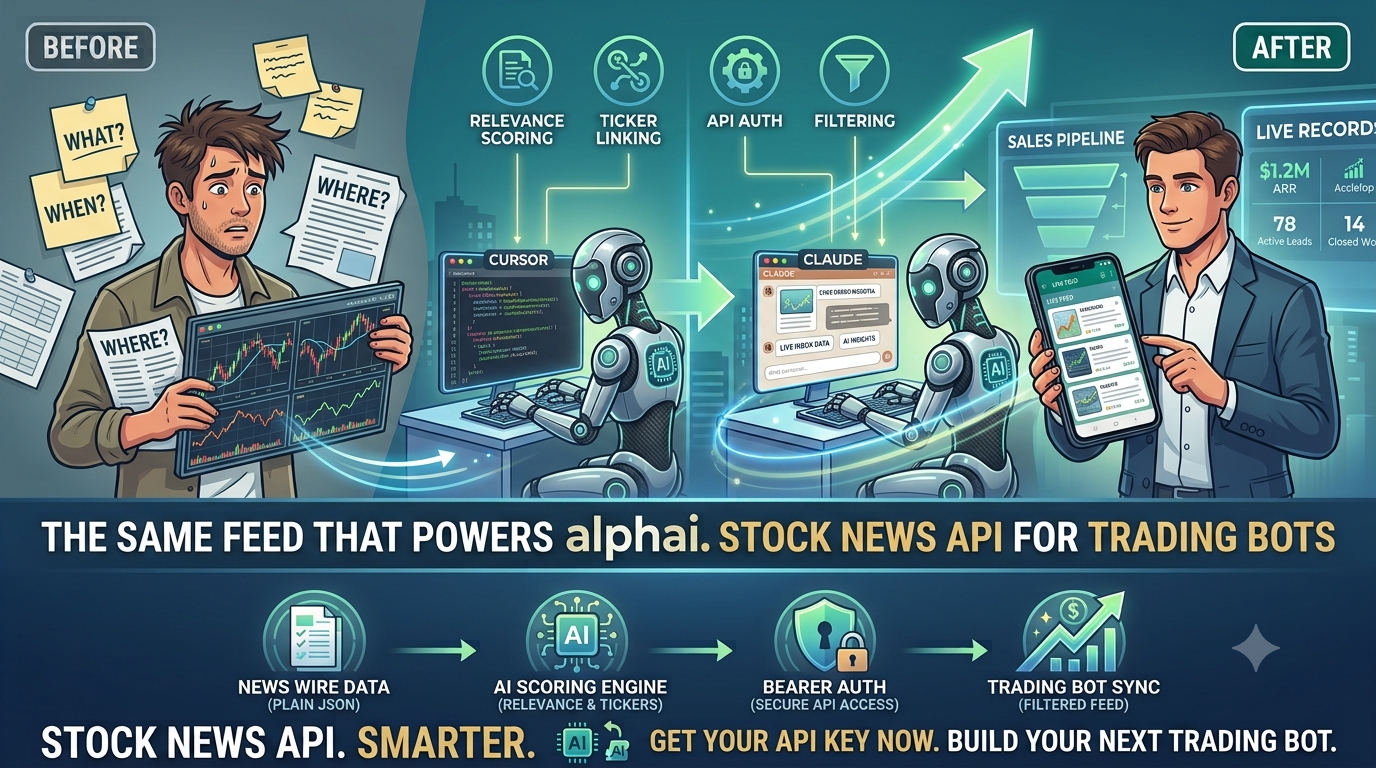
Let me start this AlphaAI review by being honest about a problem that anyone who has built a trading bot has run into. Raw financial news is noisy. By the time you filter out press releases, PR spam, and stories that barely touch the tickers you care about, you have spent most of your engineering time on plumbing instead of strategy.
AlphaAI is a stock news API built specifically for trading bots and AI agents. Instead of dumping thousands of headlines at you and hoping you sort it out, it filters, scores, and annotates the news on its side, then hands you clean JSON with relevance scores, extracted tickers, and per-ticker sentiment. The tagline on the official site says it all: a stock news API for trading bots, by the request.
What Problem AlphaAI Solves
Market data APIs give you prices and candlesticks. That is useful, but prices do not tell you why a stock moved. AlphaAI is deliberately different. It delivers the news and the analysis: what happened, which stocks it affects, and how important it is. Many teams use it alongside a market data API, pairing the "what" of price with the "why" of news.
The core pain points it targets:
- Information overload: thousands of headlines a day, most of them irrelevant to your watchlist
- Noisy sources: press releases and PR spam that waste model context and API calls
- Missing context: headlines with no ticker mapping, no sentiment, and no sense of importance
- Slow pipelines: building your own scraper, deduplicator, and scoring layer takes months
- Hallucinated tickers: naive extraction pulls symbols that are not actually mentioned in the story
AlphaAI was designed to remove those layers of work so a small team can ship a functional trading signal system quickly.
How AlphaAI Works Under the Hood
The official documentation describes a four stage pipeline that runs before any request reaches you. Understanding it explains why the output is so clean.
1. Collect
AlphaAI keeps an eye on global financial media around the clock. A GDELT driven monitor covers a huge swath of news, a dedicated SEC EDGAR tracker watches for Form 4 (insider trading) and 8-K filings, and curated publisher RSS feeds catch anything the automated layer misses. In total it monitors over 6,900 sources, and fewer than a fifth of the articles it sees actually make it into the API. That filtering happens on purpose.
2. Enrich
Each article is passed through an LLM that does three things: it assigns a relevance score on a 1 to 10 scale, it labels the story with a topic category, and it generates a sentiment reading per ticker along with a confidence level and a short reasoning note. You are not getting a raw headline, you are getting an interpreted one.
3. Validate
Extracted tickers are cross checked against a list of active symbols and against the article body itself. This step removes hallucinated tickers, blocks PR spam domains, and merges near duplicate stories about the same event. It is the difference between an API you can trust in production and a toy scraper.
4. Serve
Only articles that clear the relevance threshold and carry at least one verified ticker actually reach the API. Everything else is dropped before you ever see it.
The Data You Actually Get
Each news record comes back in two parts. The original block holds the basics: a unique id, the title, the publication time, the source domain, and the original URL. The enrichment block holds the intelligence: the relevance score, the category, and a ai_trading_insights array with a separate analysis for every ticker found in the story. That per ticker analysis includes sentiment direction, confidence, and reasoning text, so you can decide whether to act on it.
Freshness matters for trading. New articles reach the system within about an hour of publication, and SEC filings average closer to six minutes. On a typical day AlphaAI processes roughly 3,727 articles. At the default relevance threshold of 4 you get around 2,700 rows, and if you raise the bar to 7 that drops to about 1,000. That built in dial is exactly what a bot needs to control cost and noise.
A Look at the Endpoints
The developer docs list a set of endpoints that cover most trading workflows.
GET /api/news/is the main stream, reverse chronological with cursor pagination, ten items per page by defaultGET /api/news/trending/returns the trending stories from the last 48 hours with a relevance score of 8 or higherGET /api/news/insider/is a structured SEC Form 4 stream with trade direction, share count, price, total value, and a 10b5-1 flagGET /api/news/macro/covers macro economy, commodities, and geopoliticsGET /api/calendar/lists scheduled US macro releases like FOMC, CPI, PPI, and jobs reportsGET /api/news/{uid}/and/api/news/{uid}/related/pull a single enriched article and up to six related storiesGET /api/symbols/lets you search roughly 10,000 supported tickers, including resolving delisted or renamed symbolsGET /api/symbols/{ticker}/sentiment-summary/returns a 7 day AI sentiment summary with bullish, neutral, and bearish buckets by dayGET /api/symbols/{ticker}/insider-summary/aggregates 30 days of insider activity with buy and sell counts, dollar volume, and the 10b5-1 share
You can filter by symbol, category, exclude_categories, and min_relevance. A collapse=story parameter merges multiple articles about the same event into a single row, which is handy for keeping a clean feed. There is also a sort=ingested mode designed for incremental polling, which I will come back to.
Why the Relevance Score Deserves Attention
The score is assigned to the article itself, not to a company. That distinction matters. A routine earnings recap of a large cap stock gets a low score because it is not surprising. A small cap getting a fresh FDA approval can score high because it moves the needle. Similarly, Form 4 filings are scored on the trade itself: size, direction, and whether it ran under a 10b5-1 plan.
Scores are also deterministic. The same article always returns the same score, which matters if you are testing a strategy or auditing a signal. That consistency is a small detail that builds a lot of trust.
SDKs, MCP, and Integration Options
AlphaAI does not force you into a heavy SDK. The API is plain HTTPS JSON, so any HTTP client works. That said, official SDKs are available if you want convenience.
- Python SDK (
pip install alphai-sdk) supports sync and async, requires Python 3.10+ - TypeScript SDK (
npm install alphai-sdk) has zero runtime dependencies and works on Node, Edge, Deno, and Bun
Both handle cursor pagination, automatic retries on 429 and 5xx responses, and typed errors, which saves real time in production.
For AI agent use cases there is an MCP server exposing 13 tools over Streamable HTTP, supporting either OAuth 2.1 for interactive clients or a Bearer header for headless agents. That is the piece that lets a tool like Claude ask a question such as "what is happening with NVDA today" and get a filtered, scored answer instead of a messy dump.
There are also no code options. An n8n template covers low code workflows, a Postman collection helps you explore the API, a terminal dashboard called alphai-tui is useful for quick checks, and sample projects like an email newsletter digest show a full deployment pattern.
Typical Use Cases
The docs call out five workflows that feel realistic for this product.
- AI agent Q&A: an agent asks about a ticker and pulls a scored news summary through the MCP tools
- Watchlist alerts: filter by
category=earningswithmin_relevance=7to catch high impact earnings news on your list - Telegram bots: build a market briefing bot in about ten minutes on the trending endpoint
- Insider monitoring: ask which of your watchlist tickers saw insider buying this week
- AI agent news feeds: feed scored financial news to agents via MCP with OAuth 2.1
That last one, feeding context to an AI agent, is where the product shines. Because the news is already scored and deduplicated, an agent burns far fewer tokens reading only the stories that matter.
Incremental Polling Without the Missed Articles
A subtle technical detail in the docs is worth highlighting for anyone running a production bot. Articles do not enter the system at the moment they are published. The median delay for regular news is about 33 minutes, and SEC filings take five to nine minutes. If you track progress by time_published, you will silently miss late arriving articles.
The fix is the sort=ingested mode, which returns articles in the order they entered the system. Each response carries a next_cursor, and an empty result means you are caught up. The docs recommend polling with a 60 second cache and draining the loop until you get an empty page before sleeping. One catch: you cannot mix cursors between the default mode and the ingested mode, doing so returns a 400. It is the kind of detail that only shows up in a genuinely useful review, and it is exactly what keeps your bot from dropping stories.
Webhooks for Event Driven Systems
Pro accounts can register HTTPS endpoints to receive pushes instead of polling. The webhook implementation follows Stripe style patterns, which is a good sign:
- HMAC-SHA256 signature verification on every event
- Deduplication so a single event is pushed once even from multiple sources
- Exponential backoff retries across 1m, 5m, 30m, 2h, and 12h intervals
- SSRF protection that rejects private and loopback addresses
- A cap of five endpoints per Pro account
- Automatic disabling after ten consecutive 5xx responses, with an email notification
For a trading system that needs to react quickly, this removes the polling loop entirely and keeps the integration secure.
Pricing: Free Tier and Production Plans
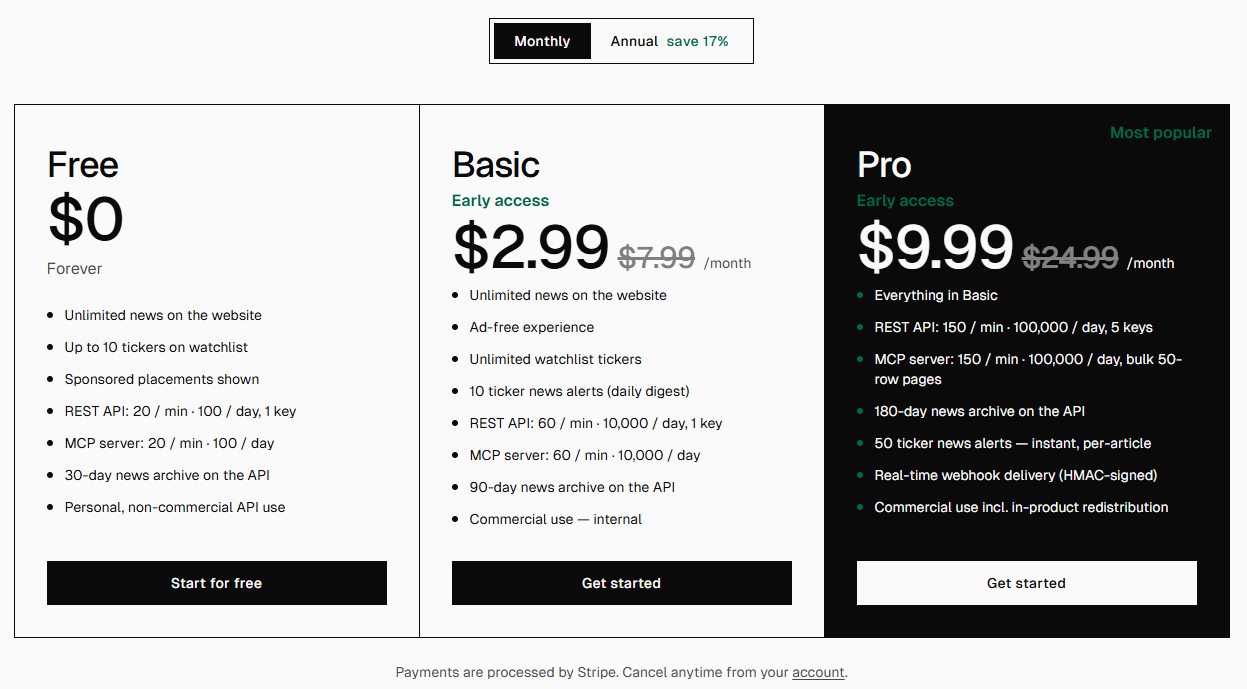
Pricing is transparent and mostly a question of scale. Quotas are per account rather than per API key.
| Plan | Rate Limit | Archive Depth | Active Keys | Best For |
|---|---|---|---|---|
| Free | 20 req/min, 100 req/day | 30 days | 1 | Evaluation and prototyping, non commercial |
| Basic | 60 req/min, 10,000 req/day | 90 days | 1 | Production workloads |
| Pro | 150 req/min, 100,000 req/day | 180 days | 5 | Large scale and commercial use |
The Free tier is genuinely useful for evaluation and prototyping, and it does not require a credit card to start poking at the playground. For a real trading system you will likely want at least the Basic plan for the production rate limits. Response headers carry X-RateLimit-Limit, X-RateLimit-Remaining, and X-RateLimit-Reset, and a 429 includes a Retry-After header plus an upgrade hint.
Who Should Use AlphaAI
This is a focused product for a specific audience, so let me be clear about who it fits.
- Quant developers building trading bots that need a clean, scored news feed
- AI agent builders who want their models to reason over filtered financial news
- Retail traders building personal alert bots on a watchlist
- Fintech startups shipping features that surface market news to users
- Insider trading trackers who want structured Form 4 data without scraping EDGAR themselves
- Macro analysts who want scheduled release dates and geopolitics in one place
If you just need candlestick data, this is not the tool for you. But if the gap in your stack is the news layer, AlphaAI fits cleanly.
Final Verdict
After digging through the developer documentation, AlphaAI comes across as a purpose built tool that respects the developers who use it. The filter first, deliver second philosophy is the real value. Instead of pushing raw noise downstream and making your bot or agent pay for it, the scoring, validation, and deduplication happen before you ever make a request.
The four stage pipeline and the deterministic relevance scoring give me confidence that the output is consistent and auditable. The per ticker sentiment with confidence and reasoning is more useful than a single headline sentiment number. And the ingested sort mode plus webhooks show that the team has thought about real production concerns, not just a demo API.
What impressed me most is how much you get for free when you are still evaluating. The ability to filter by relevance and category, the structured insider data, and the MCP integration all point to a product built by people who understand how trading systems actually work.
Ratings
- Data Quality: 5/5
- Ease of Integration: 5/5
- Documentation: 5/5
- Reliability: 5/5
- Value for Money: 5/5
- Overall Review Score: 5/5
Ready to add scored financial news to your stack? Check out AlphaAI and start with the Free plan to see how a stock news API built for trading bots and AI agents handles the noise for you.
Tags
# Review# AlphaAI review# stock news API# financial news API# news API for trading bots# AI agent news API# trading bot data# finance news feed# market news API# ticker sentiment analysis# SEC Form 4 insider trading# macro news API# earnings news API# relevance scoring# news webhook# Python SDK# TypeScript SDK# MCP server# n8n finance# quantitative trading# algorithmic trading news# financial data for AI# stock market API# news sentiment API# insider trading news# news aggregation API# developer finance APIQR Cake Review: A Free Dynamic QR Code Generator That Never Expires
TickTappy Review - The Minimalist One-Tap Time Tracker That Just Works
Follow for new blogs
Subscribe to our blog
Subscribe to Newsletter
Subscribe to our newsletter to get the best products weekly.